
Step 5: Leave the Weed Alone
After treatment, there is no need to pull or disturb the weed immediately.
Allow the heat damage to take effect.
The leaves may soften, darken, and collapse as the plant dries out.
Once dead, the remaining growth can be swept away or pulled from the crack much more easily.
How Fast Does It Work?
Young annual weeds can respond very quickly.
Visible wilting may happen within minutes, while browning often becomes more obvious over several hours.
Some plants may be dead by the following day.
Older or perennial weeds may take longer and may require another treatment.
Why Some Weeds Come Back
Not all weeds are equally easy to kill.
Many annual weeds have shallow root systems and can be severely damaged by one application.
Perennial weeds may have:
- Deep taproots
- Underground rhizomes
- Bulbs
- Stored energy reserves
If only the top growth is damaged, the plant may send up new shoots from surviving roots.
Repeat Treatment for Stubborn Weeds
If new growth appears several days later, repeat the boiling-water treatment.
Repeatedly destroying fresh leaves forces the plant to use stored energy to regrow.
Over time, this can weaken certain weeds significantly.
Why This Method Is Useful
- No conventional herbicide required
- Uses a common household resource
- Works quickly on small weeds
- Leaves no long-lasting chemical residue
- Useful in cracks where hand-pulling is difficult
- Requires little physical effort
It Is Especially Good for Hard Surfaces
Boiling water makes the most sense in areas where you do not want plants growing at all.
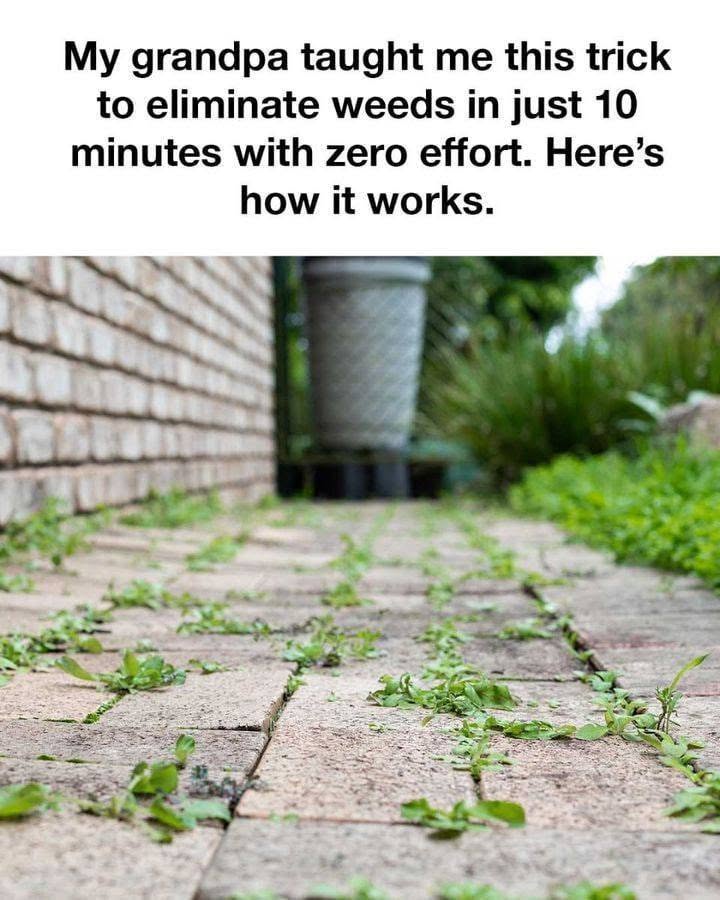
For example, weeds between paving stones can be difficult to pull because roots are trapped beneath narrow joints.
Hot water can reach into those cracks more easily than your fingers or garden tools.
Do Not Use It in the Lawn
Boiling water is non-selective.
That means it can damage almost any plant tissue it touches.
If you pour it over a weed growing in turf, the surrounding grass may be burned as well.
The result can be a dead patch larger than the weed you were trying to remove.
Be Careful Around Trees and Shrubs
Avoid pouring boiling water close to exposed tree roots, shrub stems, or desirable plants.
Heat can damage living tissue below the soil surface as well as above it.
What About Vegetable Gardens?
This method is not ideal among closely spaced vegetables because accidental splashing can damage crops.
Hand pulling, mulching, hoeing, or other targeted approaches usually provide better control in planted beds.
Do You Need Salt?
No.
Adding salt is often suggested online, but it is usually unnecessary.
Salt can remain in soil and make it difficult for desirable plants to grow later.
It can also move with water into surrounding soil.
For that reason, plain boiling water is generally the simpler and more soil-friendly option.
Do You Need Vinegar?
No.
Vinegar is another common homemade weed-control suggestion, but it is not required for the boiling-water method.
Household vinegar can burn plant leaves, but repeated or concentrated use may also affect nearby vegetation and some surfaces.
Hot water alone is often sufficient for young weeds in pavement cracks.
Should You Add Dish Soap?
There is usually no need.
Dish soap may help certain spray mixtures stick to plant surfaces, but boiling water already makes direct contact with the weed.
Keeping the method simple also avoids unnecessary detergent entering soil or stormwater.
The biggest advantage of this old trick is its simplicity—but using it in the right place matters just as much as the temperature of the water.
