
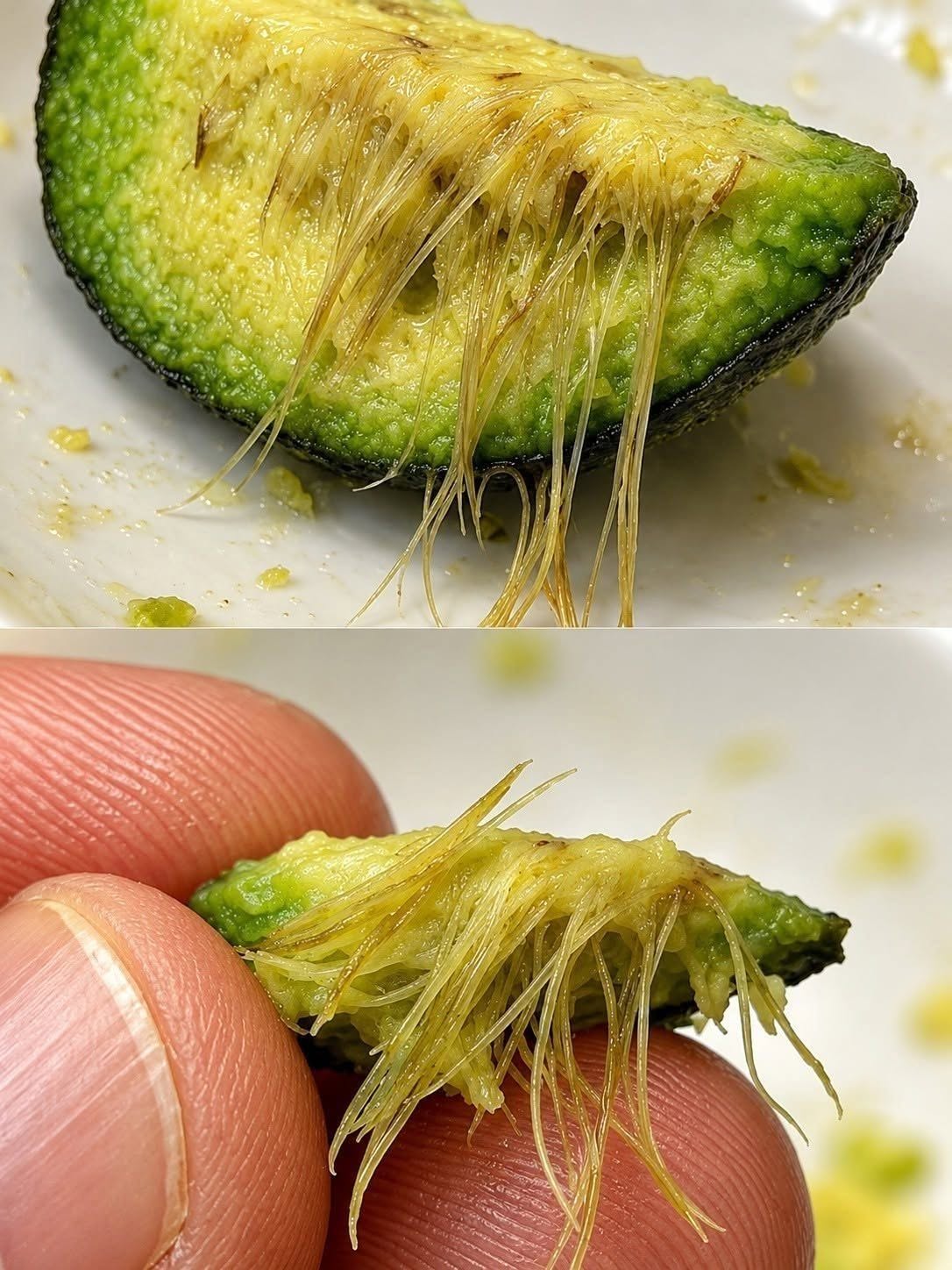
You cut open an avocado expecting smooth, creamy green flesh—and instead discover thin brown, tan, or yellowish strings running through the fruit.
It can look strange enough to make you wonder whether the avocado is spoiled, unsafe to eat, or simply poor quality.
The reassuring answer is that stringy fibers inside an avocado are usually not a sign of dangerous spoilage. In most cases, they are part of the fruit’s natural internal structure.
Understanding what those fibers are, why they sometimes become more noticeable, and how to recognize true signs of spoilage can help you decide whether the avocado belongs in your recipe or in the trash.
What Are the Strings Inside an Avocado?
The thin strands you sometimes see inside an avocado are known as vascular bundles.
These bundles form part of the avocado’s natural internal transport system.
While the fruit develops on the tree, vascular tissue helps move water and nutrients throughout the growing avocado.
Every avocado contains this tissue.
In a perfectly smooth avocado, the fibers are usually so fine and tender that you barely notice them.
Sometimes, however, those bundles become thicker, tougher, darker, or simply much more visible.
That is when the flesh develops the stringy texture that can make an otherwise normal avocado look suspicious.
Why Are Some Avocados More Stringy Than Others?
Several factors can influence how noticeable the vascular bundles become.
1. The Avocado May Have Come From a Younger Tree
Fruit characteristics can change as avocado trees mature.
Avocados from younger trees may sometimes develop more prominent vascular fibers.
The bundles can be thicker and slightly tougher, making them much easier to see when the fruit is sliced open.
This does not necessarily mean there is anything wrong with the avocado.
It may simply have a less desirable texture.
2. Growing Conditions Can Affect Texture
Avocados are sensitive to environmental conditions while developing.
Temperature fluctuations, water availability, and other growing stresses can influence the texture of the fruit.
Under certain conditions, the vascular tissue may become tougher or more pronounced.
Two avocados of the same variety can therefore look very different inside even if they appear nearly identical on the outside.
3. Storage Conditions May Play a Role
Avocados continue to change after harvesting.
Temperature during transport, storage, and ripening can affect their final texture.
Improper storage can contribute to uneven ripening, internal discoloration, or firmer fibers.
4. The Avocado May Be Overripe
As an avocado becomes very ripe, its creamy flesh gradually softens and begins to break down.
The vascular fibers may not soften at the same rate.
As the surrounding flesh becomes softer, the strings suddenly stand out much more clearly.
This is one reason an avocado can look perfectly ordinary from the outside yet appear noticeably stringy when opened.
The important point is that visible strings alone do not mean the avocado is spoiled. The smell, texture, color, and overall condition of the fruit matter much more.
