
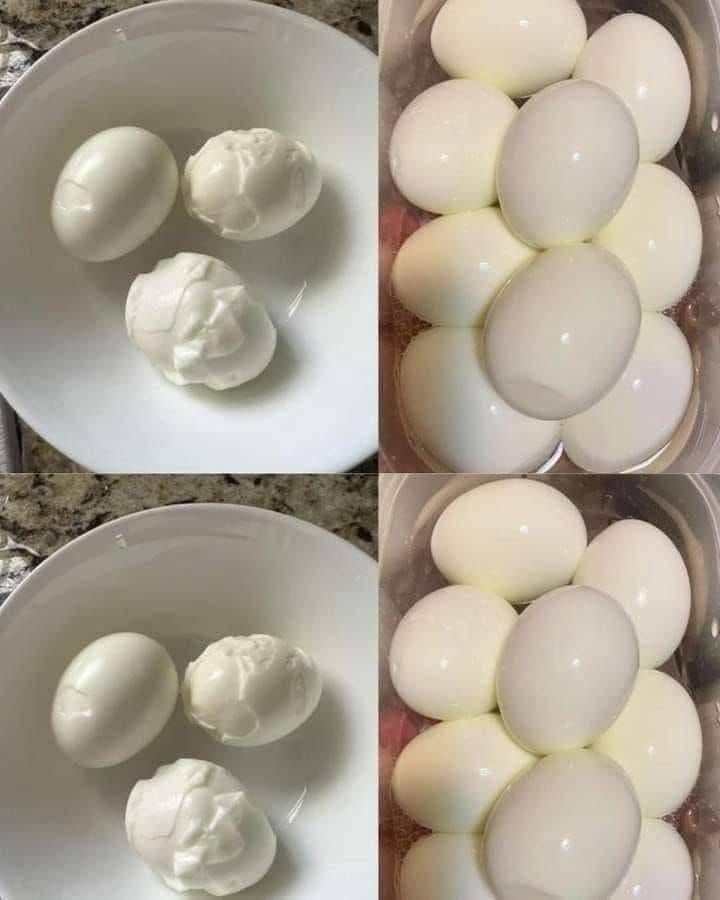
How to Cook Hard-Boiled Eggs for Easier Peeling
Start by placing the eggs in a saucepan in a single layer. Add enough water to cover them comfortably.
Bring the water to a boil, then cook the eggs using your preferred hard-boiled egg method. Cooking times vary depending on egg size and technique, but the goal is a fully set white and yolk without excessively overcooking them.
Another commonly used method is to lower the eggs carefully into water that is already boiling or simmering. Starting eggs in hot water can sometimes make peeling easier because the egg white sets more quickly near the shell.
Whichever method you choose, handle the eggs carefully to prevent cracking while they cook.
Cooling the Eggs
After cooking, cool the eggs promptly in cold water. An ice-water bath is convenient because it stops the cooking process quickly and makes the eggs easier to handle.
Cooling alone does not guarantee easy peeling, but it can help firm the cooked egg and prevent the yolk from continuing to cook.
Leave the eggs in the cold water for several minutes before peeling.
How to Crack the Shell
Tap the egg gently on a hard surface, then roll it lightly under your palm to create fine cracks across the shell.
Try to avoid crushing the shell too aggressively, as sharp pieces can cut into the egg white.
Many people find it easiest to start peeling from the wider end of the egg, where an air pocket is often located. This can give you a little more room to get under the shell membrane.
Peel Slowly and Follow the Membrane
Once you have lifted a small section of shell, try to get your fingertip beneath the thin membrane rather than removing tiny shell fragments one by one.
If the membrane begins to come away in a larger sheet, the shell often follows with it.
When the shell resists, dip the egg back into the water and gently work more water under the membrane rather than forcing it.
Why Some Eggs Are Still Difficult to Peel
Even with good technique, some eggs simply peel better than others. Differences in freshness, storage conditions, cooking temperature, and individual egg structure can all affect the result.
This is why it is better to think of these techniques as ways to improve your chances rather than as absolute guarantees.
Do You Need Baking Soda or Vinegar?
Some home cooks add baking soda or vinegar to the cooking water in hopes of making eggs easier to peel.
Baking soda raises the alkalinity of the water and may influence the egg white near the shell, while vinegar can help if a shell cracks during cooking because the acid encourages leaking egg white to coagulate more quickly.
However, neither ingredient is essential for producing peelable hard-boiled eggs.
Using eggs that are not extremely fresh, cooking them consistently, cooling them promptly, and peeling with water are simple methods that require no extra ingredients.
Best Way to Store Hard-Boiled Eggs
If you are not eating the eggs immediately, refrigerate them promptly after cooking and cooling.
For best quality, hard-boiled eggs are generally kept refrigerated and used within about one week.
Leaving the shells on until you are ready to eat them can help protect the eggs from drying out and absorbing odors from other foods in the refrigerator.
If the eggs have already been peeled, keep them in a covered container in the refrigerator.
The Bottom Line
If cleanly peeled hard-boiled eggs have always felt like a matter of luck, the simplest improvement may be to combine two easy habits: avoid using extremely fresh eggs when appearance matters, and peel the cooked eggs with the help of cool water.
The change in the egg white as eggs age can make the membrane easier to separate, while water helps slip beneath the shell and wash away small fragments.
It may not produce a flawless egg every single time, but it can make hard-boiled egg peeling quicker, cleaner, and much less frustrating.
