
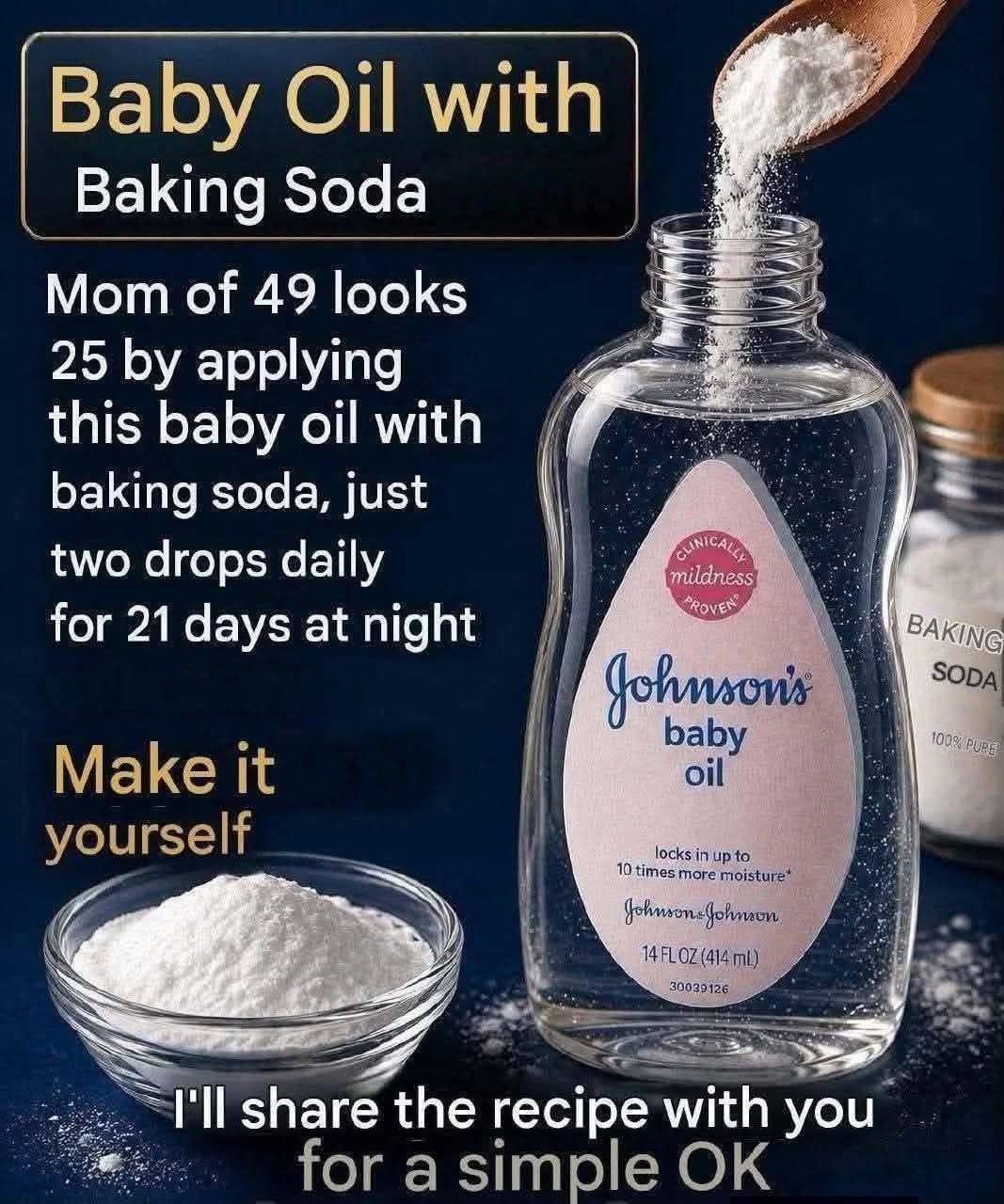
The promise sounds almost irresistible: combine two inexpensive household products, apply them to your skin, and supposedly wake up with a softer, brighter, younger-looking face.
Baby oil and baking soda are both easy to find, which is one reason this skincare trick continues to circulate online. But simple ingredients are not automatically suitable for facial skin, and understanding what each one actually does can help you avoid irritation while still getting the softness you are looking for.
Baby oil can be useful for reducing moisture loss, while baking soda is much more controversial. It is alkaline and can disrupt the naturally acidic protective environment of healthy skin, especially when used repeatedly.
So before trying the viral mixture for several days or weeks, it is worth separating the realistic benefits from the exaggerated claims.
What Baby Oil Actually Does
Most traditional baby oils are made primarily from highly refined mineral oil, sometimes combined with fragrance.
Mineral oil is an occlusive ingredient. That means it forms a thin protective layer over the skin that reduces the amount of water escaping from the surface.
This can make dry skin feel noticeably softer and smoother.
Baby oil is particularly effective when applied to slightly damp skin because it helps trap some of that existing moisture underneath the oily barrier.
Does Baby Oil Hydrate the Skin?
Baby oil does not add large amounts of water to the skin by itself.
Instead, it helps prevent moisture that is already present from evaporating too quickly.
For this reason, it works particularly well after bathing or washing, when the skin is still slightly damp.
Does Baby Oil Contain Anti-Aging Ingredients?
Not necessarily.
Plain mineral oil does not provide the same types of active skincare ingredients found in products containing retinoids, vitamin C, niacinamide, peptides, or other specifically formulated actives.
Its main advantage is moisture retention.
Well-moisturized skin can temporarily appear smoother and more plump, which may make fine dehydration lines less noticeable.
That effect should not be confused with permanently removing wrinkles.
What About Baking Soda?
Baking soda, or sodium bicarbonate, is alkaline.
Healthy facial skin naturally maintains a mildly acidic surface environment that helps support its protective barrier.
Applying strongly alkaline products can interfere with this balance.
Repeated use of baking soda may cause:
- Dryness
- Redness
- Stinging
- Irritation
- Increased sensitivity
- Disruption of the skin barrier
Does Baking Soda Balance Skin pH?
No.
This is one of the most important misconceptions surrounding the mixture.
Baking soda does not restore the skin’s normal acidic pH. Because it is alkaline, it can temporarily push the skin in the opposite direction.
That does not mean one accidental use will permanently damage healthy skin, but frequent facial use is generally not a good idea.
Why Does Skin Sometimes Feel Smooth After Baking Soda?
Baking soda has a slightly gritty texture, so rubbing it across the skin can physically remove some loose surface cells.
This can temporarily make the skin feel smoother.
However, aggressive physical exfoliation is not necessary for healthy skin and may cause microscopic irritation, especially on the face.
The biggest problem with the viral recipe is not the baby oil—it is the repeated use of alkaline baking soda on delicate facial skin.
